- calendar_today August 16, 2025
.
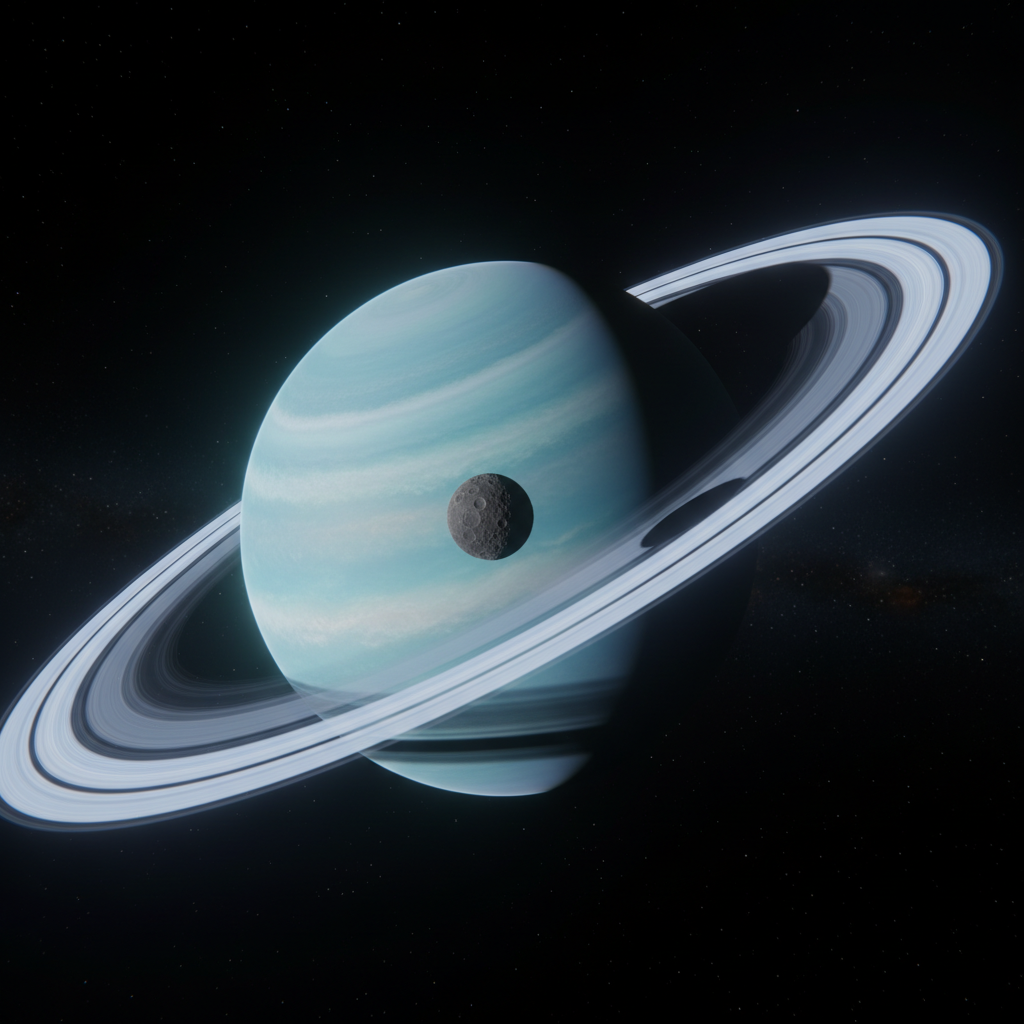
Long-exposure images from NASA’s James Webb Space Telescope (JWST) have revealed a previously unknown moon orbiting Uranus, bringing the total number of moons known to orbit the ice giant to 29. Astronomers believe there are likely more yet to be discovered.
The small moon, just 6 miles (10 kilometers) across, was discovered on Feb. 2 in a series of 40-minute-long exposure images taken by Webb’s Near-Infrared Camera. The tiny satellite is one of the smallest natural Uranian satellites ever discovered. It is so dark, small, and quick-moving that its faint silhouette was hidden in the glare of Uranus’ bright rings, and even NASA’s Voyager 2 spacecraft, which flew by Uranus nearly 40 years ago, missed it.
“This is a small moon but a big deal,” said Maryame El Moutamid, lead scientist in the Southwest Research Institute’s Solar System Science and Exploration Division in Boulder, Colorado, and principal investigator of a Webb program exploring Uranus’ rings and inner moons. “Discoveries like this are important because they demonstrate how Webb is taking us well beyond the reaches of previous planetary missions.”
Webb is a large infrared telescope that gives astronomers the ability to study celestial objects with a faint infrared glow. Thanks to its ultraprecise infrared sensors, Webb has begun peering at Uranus’ rings, weather, and atmosphere. The new moon, known for now as S/2025 U1, orbits Uranus at a distance of 35,000 miles (56,000 kilometers) from the planet’s center. It orbits near the planet’s equator in a nearly circular orbit sandwiched between the known moons Ophelia, just outside the planet’s bright main ring system, and Bianca. The orbit is consistent with S/2025 U1 having formed in its current location.
The new moon is so dark, small, and fast-moving that astronomers had to use Webb to disentangle it from the glare of Uranus and its rings. In the new research, which has not yet been published in a peer-reviewed journal, Webb provided the first direct identification and orbital measurement for this elusive and tiny satellite.
“It’s been gratifying to discover a new moon with Webb and already to get a glimpse into its relationship to Uranus’ rings, weather, and atmosphere,” El Moutamid said. “This gives us context for the data we will collect as we continue to monitor the planet with Webb.”
Because it is faint, El Moutamid and her team spent more than 100 hours carefully processing the images. The discovery is a remarkable addition to a body of work that began a few months ago when the same team first used Webb to study the ice giant. Their first observations were only exposures of a few minutes, so the tiny new moon wasn’t visible in the first data released to the public. Subsequent, longer exposures teased out the details of Uranus’ rings and now the new moon.
Explaining Uranus’ Complex Rings and Moons
Scientists believe S/2025 U1 may have been born with parts of Uranus’ ring system. The newest moon and those rings could be pieces of a larger structure that broke up in a past collision or some other ancient event. “The discovery raises questions about how many more small moons remain hidden around Uranus and how they interact with its rings,” El Moutamid said.
At present, Uranus is known to host five major moons—Miranda, Ariel, Umbriel, Titania, and Oberon—and a retinue of smaller satellites. The newly discovered body will be the 14th small moon in the planet’s inner system. No other planet has as many small inner moons so close to the planet and to each other. Astronomers are mystified by how so many objects can orbit so close together. Their orbits are so close that they would normally cross, but somehow they all appear to be stable. Scientists think the satellites may be shepherding Uranus’ narrow rings.
The team’s discovery is a particularly “exciting” find because the newly discovered object “appears to be very close to Uranus’ inner ring system, so it may have some kind of dynamical relationship with the rings and other satellites in the system,” said Scott Sheppard, an astronomer at the Carnegie Institution for Science who was not involved in the new study but did co-discover a Uranus moon in 2024. “I congratulate the Webb team on their great discovery, as Webb’s sensitivity will allow us to see more of these tiny moons around Uranus than has been possible before.”
NASA’s SETI Institute’s Matthew Tiscareno, a co-principal investigator in the Webb Uranus project, said this find shows how fuzzy the line can be between what is considered a moon and what is considered a ring. “Their complex inter-relationships hint at a chaotic history for these inner satellites that we only just started to reveal with the discovery of this new, and even smaller moon that is fainter than the tiniest known Uranian inner moons,” Tiscareno said. “Our new moon is also likely not alone; other small moons should remain hidden.”
The past and future of Uranus’ moons
Historically, Uranus’ moons have come to light bit by bit. Before Voyager 2’s historic flyby in 1986, only five moons were known, the largest of the bunch. Astronomers have been aware of Uranus’ moons since at least 1787, when Uranus’ first two moons, Titania and Oberon, were discovered. Voyager 2 discovered 10 more moons on its way past. They are between 16 and 96 miles (26 and 154 kilometers) in diameter. Ground-based telescopes and the Hubble Space Telescope discovered 13 more small moons, each between 8 and 10 miles (12 and 16 kilometers) across. Unlike the outer moons, which are thought to be captured asteroids, the inner moons are likely ice-rock mixtures.
In the future, new moons may come to light at Uranus. A planetary decadal survey published in 2022 by the National Academies of Sciences, Engineering, and Medicine has recommended that NASA’s next big planetary project be a Uranus Orbiter and Probe mission. It would have to launch in the early 2030s to reach the planet at the same time as an ESA-led mission to Neptune that would also explore Uranus. But while budget talks are pending, there are no firm plans or money set aside for the Uranus mission. A NASA/Uranus mission could explore the planet’s tilted rotation axis, its complex magnetic field, its atmosphere and weather, and potentially ocean worlds in its icy satellites.
Sheppard suspects there are other moons awaiting discovery that are no bigger than a few kilometers in diameter. Some of them may be waiting for Webb or another spacecraft to detect them. El Moutamid and her team are planning to use Webb to track the new moon and search for more hidden ones.
“Discovering a new moon around Uranus not only helps us to better understand how this strange system formed,” El Moutamid said, “but it also sheds light on the rings and will be an important milestone to prepare for future missions like NASA’s Uranus Orbiter and Probe mission.”