- calendar_today August 20, 2025
Scientists from Carnegie Mellon University have introduced LegoGPT, which transforms plain language descriptions into stable Lego builds using AI technology. The system stands out because it produces Lego designs based on text instructions and guarantees these designs are practically buildable by humans or robots. LegoGPT functions by interpreting written instructions like “a streamlined, elongated vessel” or “a classic-style car with a prominent front grille” to produce detailed sequences of brick placements that build structurally sound Lego models. The creation of a functional large language model that predicts Lego brick arrangements comes from training it with more than 47,000 physically stable Lego designs, which have corresponding descriptive captions produced by OpenAI’s GPT-4.
The training process teaches AI how to connect language descriptions with stable Lego configurations, which allows it to forecast the next brick in the sequence that preserves the structure’s stability. LegoGPT builds upon large language model principles similar to ChatGPT, though it focuses on predicting the next brick instead of the next word. The researchers enhanced Meta’s LLaMA-3.2-1 B-Instruct instruction-based language model by fine-tuning it and adding a specialized tool driven by mathematical models to simulate gravity forces and structural integrity, which verifies the physical stability of their designs. LegoGPT’s innovative “physics-aware rollback” feature examines structural weaknesses during design creation and refines the layout by experimenting with brick placement alternatives to improve final product stability from 24 percent to 98.8 percent.
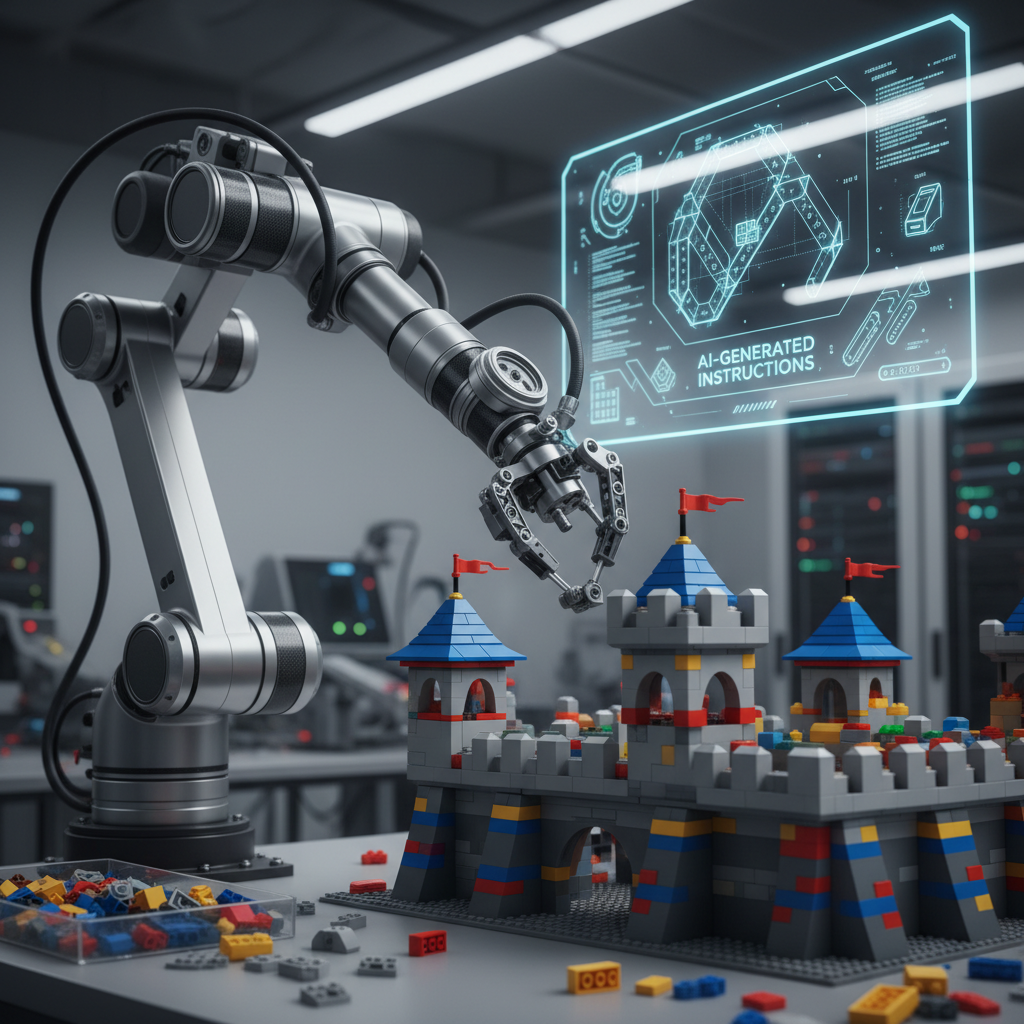
The researchers performed rigorous experiments with both robotic systems and human builders to confirm LegoGPT’s design applicability in real-world settings. Researchers assembled the AI-generated models using a sophisticated dual-robot arm system featuring force sensors, which allowed precise manipulation based on predetermined brick sequences. The evaluation process included human testers who physically assembled selected AI-designed models, demonstrating that LegoGPT produces real-world buildable and stable Lego structures that adhere closely to the original text prompts. The experiments proved that the system could transform text descriptions into actual Lego models that look like the original designs while maintaining the necessary stability for real-life construction. The ability of both robots and humans to construct models demonstrates how effective and reliable the AI-generated building instructions are.
Compared to other AI systems for 3D creation, such as LLaMA-Mesh, LegoGPT excels with its fundamental commitment to structural integrity. Team assessments proved that their method consistently produced a much larger proportion of stable structures than alternative techniques, which tend to focus on visual appearance rather than structural viability. LegoGPT functions in a fixed building space measuring 20×20×20 units and makes use of eight standard brick types. The researchers recognize the current system limitations and have detailed their intentions to develop the system for managing bigger and more sophisticated structures with diverse brick types, including slopes and tiles. The system expansion will probably require additional improvements to both the AI model and physics simulation due to the increased complexity.
LegoGPT’s achievement of merging language comprehension with physics simulation represents a major advancement in AI-based physical construction design. The foundational principles and methods behind LegoGPT show significant potential for use across various fields, including architecture and engineering, beyond its original toy design application. This tool enables abstract textual instructions to be converted into stable, buildable physical structures, which signifies a major evolution towards practical AI design tools for making tangible objects. The development of AI-based systems like LegoGPT promises to revolutionize design and fabrication methods across multiple industries by making complex physical structure creation more accessible to everyone.